
Outdoor play offers something uniquely powerful in childhood development.
Children need movement everywhere, of course. Team sports matter. Indoor creativity matters. But outdoor play provides a different kind of developmental experience: freedom, unpredictability, exploration, sensory richness, and connection to the living world itself.
In a world increasingly designed around screens, schedules, and supervision, outdoor play gives children something rare: the opportunity to bravely navigate and explore environments that do not bend entirely to them.
Children, as a result, adapt and become part of nature.
A stick becomes a sword, a bridge, a fishing pole, or a wizard’s staff. A muddy hill becomes a challenge to conquer. A creek invites experimentation. Trees ask children to assess risk, test limits, and make decisions in real time. These moments are not trivial. They are the building blocks of executive function, self-regulation, resilience, adaptability, and confidence.
Research increasingly points to the unique “affordances” of natural environments. Outdoor spaces invite and enable forms of play, movement, imagination, and decision-making that more controlled environments often cannot. Studies on natural playscapes have shown that children engage in more varied, physically complex, imaginative, and cognitively demanding play when interacting with natural environments versus traditional or highly structured settings. Natural environments tend to foster more cooperative play, creativity, exploration, and self-directed learning than fixed indoor environments or adult-led activities.
Unlike many indoor environments, the outdoors is dynamic and alive. Weather changes. Seasons shift. Bugs crawl. Wind interrupts plans. Terrain forces adaptation. Outdoor play teaches children that the world is not perfectly controlled, and that they are capable of responding to it anyway.
Nature also introduces children to productive forms of risk.
Climbing a tree, balancing across rocks, jumping from logs, and navigating uneven ground. These experiences require children to constantly evaluate consequences, regulate emotions, adjust behavior, and make decisions. Researchers studying “risky play” have repeatedly found that natural environments provide richer opportunities for healthy risk-taking, which in turn supports motor development, emotional regulation, confidence, and problem-solving.
Children who regularly engage in outdoor play often demonstrate stronger self-regulatory behaviors and improved executive functioning because the environment itself requires planning, adaptation, and decision-making.
And importantly, outdoor play often resists over-optimization. There is no scoreboard in a creek. No perfectly designed outcome in a pile of sticks. Outdoor play allows children to become inventors, negotiators, explorers, and storytellers rather than simply consumers of entertainment or participants in adult-designed systems.
There is also growing evidence that outdoor play supports children’s mental health and emotional well-being in ways that are increasingly important in modern childhood. Exposure to natural environments has been associated with lower stress levels, improved mood, better attention restoration, and healthier social interactions. Researchers have also noted that children often experience greater feelings of autonomy and intrinsic motivation outdoors compared to highly structured indoor settings.
This is one reason many Nordic countries place such a strong cultural emphasis on outdoor exposure and nature-based learning. Across Scandinavia, “forest schools” and outdoor classrooms are not fringe ideas; they are woven into educational philosophy. Children routinely learn, play, eat, and explore outdoors in conditions many American parents might consider uncomfortable. The goal is not hardship for hardship’s sake. It is confidence, adaptability, emotional regulation, resilience, and connection to the natural world.
Organizations like UNICEF have increasingly highlighted outdoor play as essential to healthy childhood development. UNICEF argues outdoor play is critical to physical health, emotional development, social learning, creativity, and resilience. Their guidance also emphasizes something simple but profound: Children do not need perfectly curated experiences outdoors. They need time, space, permission, and opportunities to interact meaningfully with the world around them.
It's messy. And that’s the point.
Recent books like Outdoor Kids in an Inside World reinforce this growing body of thought: children thrive when they regularly experience nature, unstructured exploration, and real-world sensory engagement. Emerging research continues to point toward benefits that include improved attention, emotional regulation, physical coordination, social development, and overall well-being — especially when outdoor play includes meaningful interaction with nature itself.
The good news? Outdoor play does not require a wilderness expedition.It can look like:
letting kids climb the “slightly too tall” rock,
walking to school when possible,
building forts from sticks and blankets,
gardening together,
hiking without an agenda,
playing in the rain,
spending an afternoon at a creek instead of a screen,
or simply giving children more unscheduled time outside.
For families wanting practical inspiration, books like The Wild + Free Family and The Forest School Adventure offer approachable ideas for bringing more nature, exploration, and outdoor creativity into everyday life.
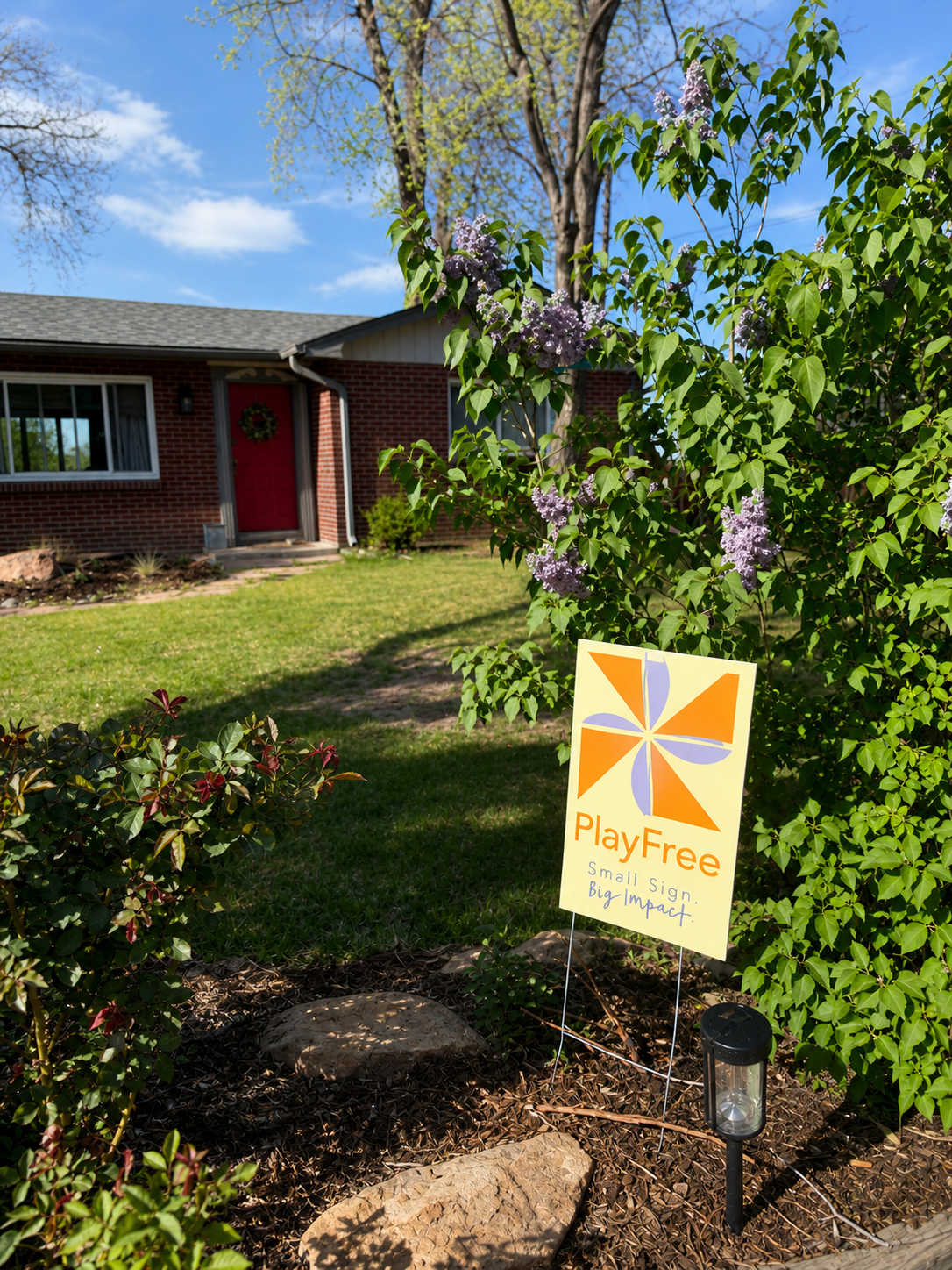
At PlayFree, we believe outdoor play is not just recreation. It is preparation for life.
It teaches children how to assess risk, solve problems, build independence, tolerate discomfort, notice beauty, collaborate creatively, and feel connected to something larger than themselves.
And perhaps most importantly, outdoor play reminds children — and adults — that the world is still wonderfully alive beyond the screen.